M2FedAQI: Multimodal Federated Learning for Air Quality Prediction on
Heterogeneous Edge Devices
Manjil Nepal,
Kimsie Phan, Tamoghna Ojha, Aritra Dutta, M Krishna Siva Prasad
arXiv preprint, 2026
paper
/
code
Abstract
Accurate air quality prediction is essential for public health, environmental monitoring, and industrial
safety. However, most existing approaches rely on centralized learning paradigms, which introduce challenges
related to scalability, privacy preservation, and communication overhead in distributed Internet of Things
(IoT) environments. Moreover, current federated learning (FL) based solutions predominantly utilize unimodal
data, limiting their capability to capture complex environmental patterns. To address these limitations, we
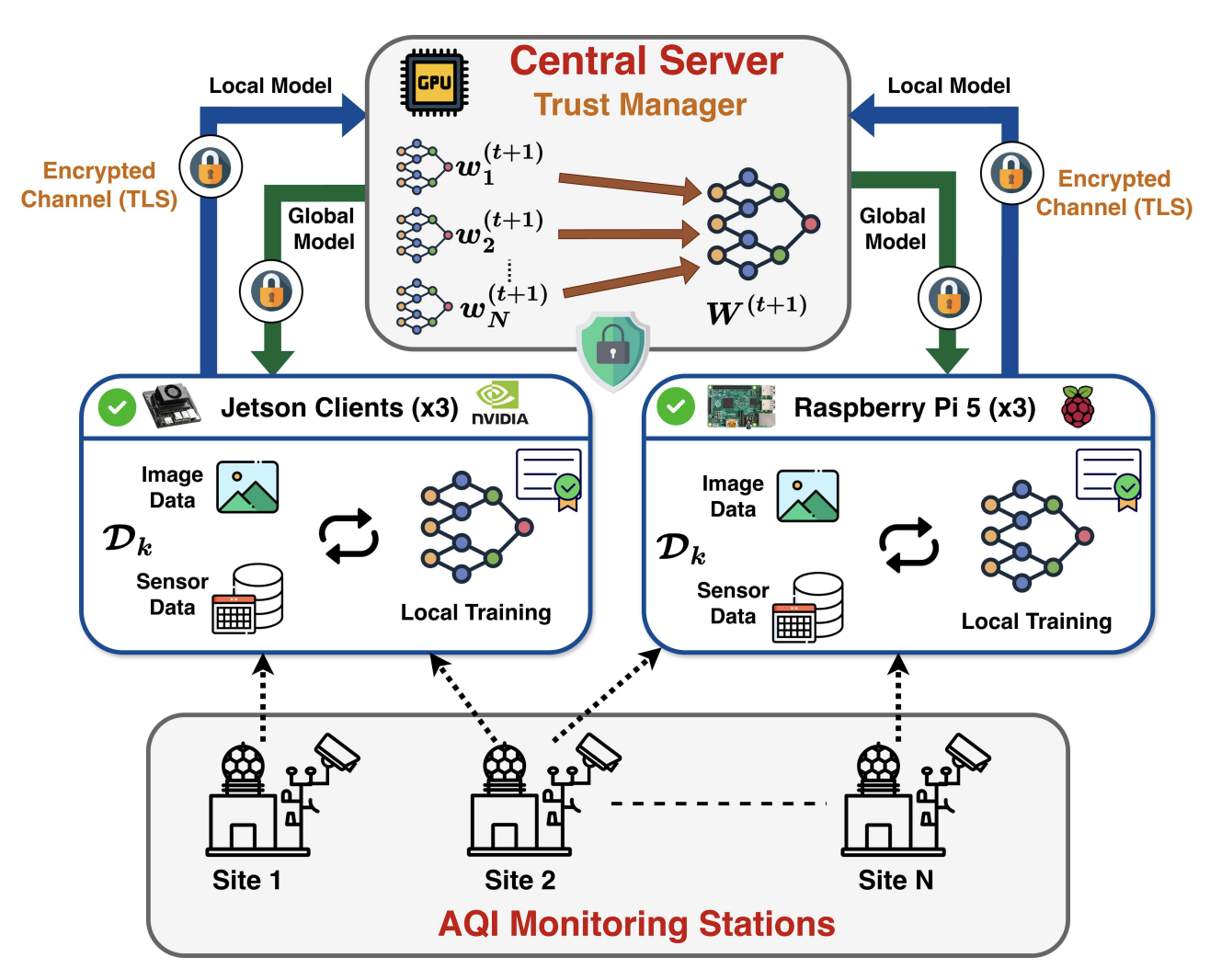
propose M2FedAQI, a lightweight multimodal federated framework for decentralized Air Quality
Index (AQI) prediction across heterogeneous edge devices. The proposed framework integrates visual and
tabular modalities through a feature modulation based fusion mechanism that enables efficient cross-modal
interaction while maintaining low computational overhead. M2FedAQI is evaluated on two benchmark
datasets, PM25Vision and TRAQID, for both classification and regression tasks under centralized and
federated settings. Experimental results demonstrate that M2FedAQI consistently outperforms
existing approaches, achieving improvements of up to 11.0% in Accuracy, 3.53% in AUC, 12.2% in F1-score, and
18.0% in R2, while reducing MAE and RMSE by up to 25.4% and 20.4%, respectively, compared with
the strongest baselines. Furthermore, deployment on heterogeneous edge devices demonstrates efficient
resource utilization in terms of communication overhead, memory footprint, and computational cost. To
enhance communication security, TLS-based authentication is incorporated to ensure secure client
participation and protect the FL communication channel from unauthorized third-party access without
modifying the underlying FL protocol.